

D.R.i.V.E. Inquiry Framework
The PEOE option for this phase offers a more structured, teacher-guided approach for exploring variables. The teacher presents a specific modification to the independent variable and asks students to predict the impact on the dependent variable.
For instance, the teacher might ask, "Predict what will happen to the final size of the marshmallow if we use a smaller syringe”.
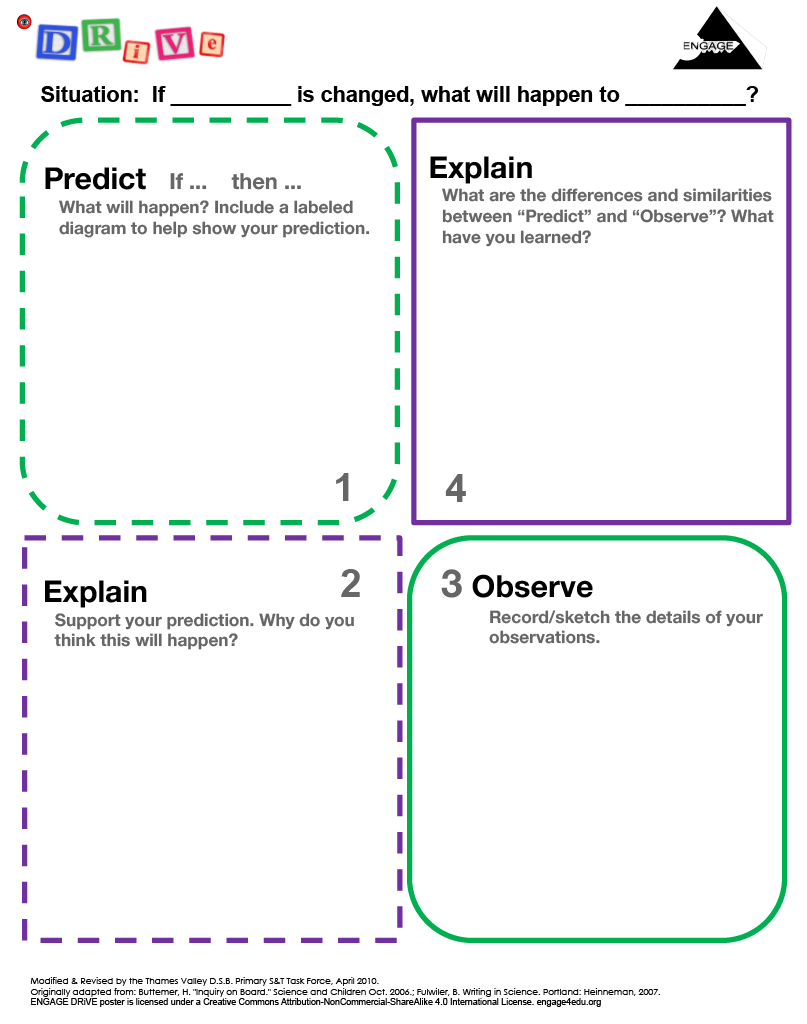
Students write a prediction statement and illustrate their prediction with a labeled diagram. They then explain the reasoning behind their prediction, drawing on their experience: replicating the demonstration, their existing knowledge, and research. Once students have experience with an event, they are better able to make predictions with explanations to back them up. A prediction without experience is a guess.
After sharing and discussing predictions, the class anonymously votes on the most likely outcome. Students then observe the modified experiment and compare their observations to their predictions, indicating whether their prediction was supported or refuted. They explain any observed discrepancies, refining their understanding based on the evidence.
This cyclical process of prediction, explanation, observation, and explanation helps students develop their scientific reasoning skills and their ability to connect theory and evidence.
-
Teacher Does
Specify a tweak to an Independent Variable (IV) that may impact the Dependent Variable(DV)
Student Does
Write a prediction statement for the impact of the proposed change.
Draw a well-labeled diagram of their prediction.
-
Teacher Does
Provide background info or opportunity for student research.
Facilitates prediction sharing.
Student Does
Write an explanation of prediction by drawing on understanding, experiences, theories, models and or insights gained from experience and research.
Share the prediction with the class. Modify this prediction or explanation based on the group discussion.
-
Teacher Does
Walk about and take note of student predictions.
List prediction options.
Facilitate group discussion
Culminate with an anonymous vote on the prediction options.
Share results of the popular vote -maintain anonymity.
-
Student Does
Decide what evidence to collect, measurements to take, and/or equipment to use to check their prediction.
Carefully measure and collect evidence
Record their observations.
-
Student Does
Write an explanation for observations.
Use theories or models to help explain evidence / results.
Believe the observations – not worry about what was expected.
State which predictions were supported or refuted.
Teacher Does
Use the opportunity to compose a group or class note to summarize the experience
Clarify background info and underlying content and skills.
Additional Resources