D.R.i.V.E. Inquiry Framework
Once students have a common experience to draw upon it is time to vary the situation. This phase is where students design and conduct experiments or engage in structured investigations to test their research questions and explore the relationships between variables. The DRiVe framework offers two options for this phase: we will focus on the Experiment option
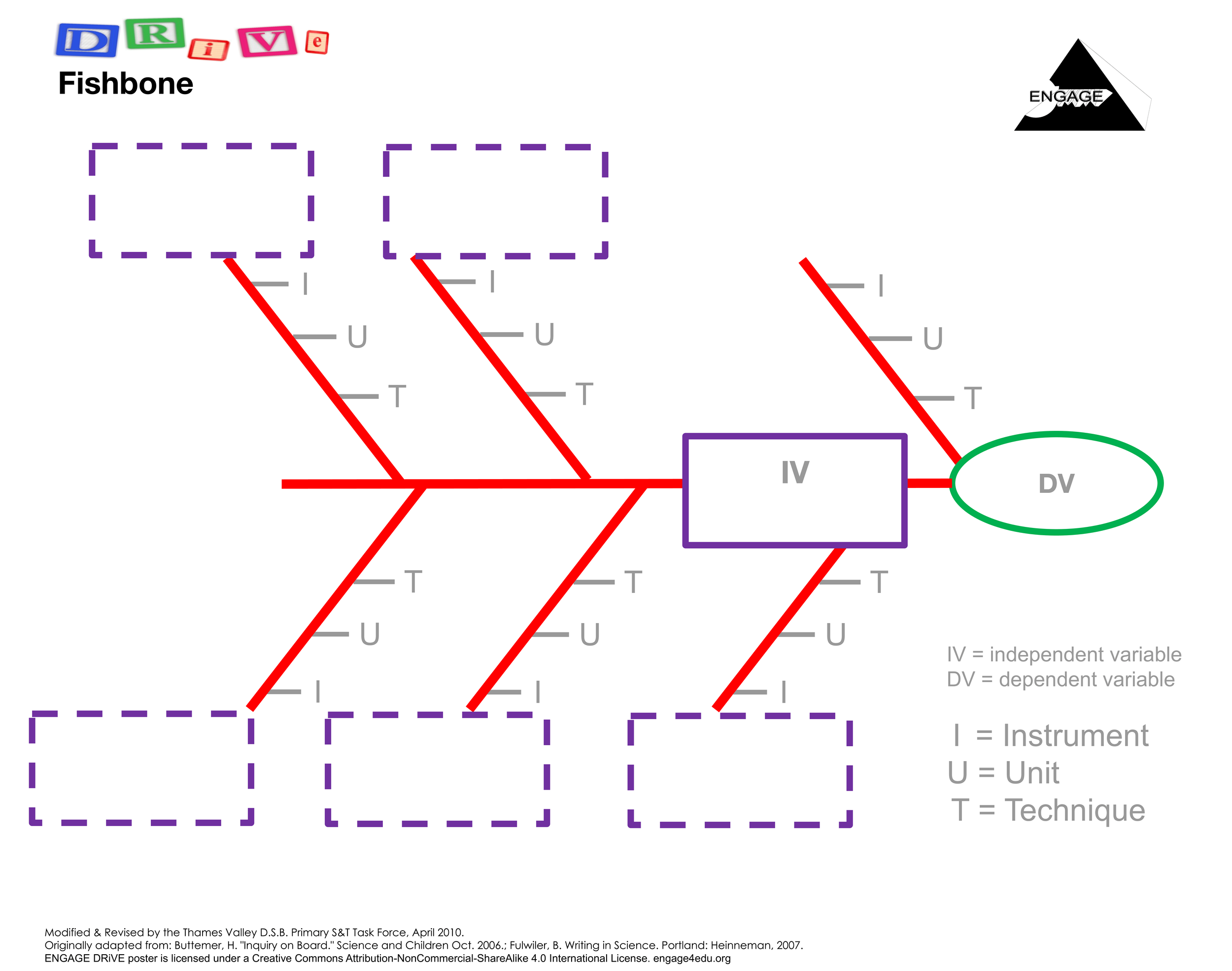
The Fishbone Organizer is used to provide structure for this open ended inquiry approach. Students move sticky notes from the Wonder organizer to identify and categorize the variables that could influence the experimental outcome. They identify the independent variable (the factor being changed), the controlled variables (factors kept constant), and the dependent variable (the factor being measured or observed).
The teacher’s role in this stage can range from highly guided to open, depending on the students’ level of experience and the learning goals
-
Decide on the variables to study.
Move the sticky note from the Wonder thought bubble to the "head of the fish" as the focus or Dependent Variable (DV) to study.
Move one of the brainstormed ideas that may affect outcome to the “body of the fish '' as the Independent Variable (IV).
Move ALL unused brainstormed variables to the positions around the outside of the fish as Control Variables (CV).
Since any of these variables could affect the results, students must be mindful and take steps to hold them constant.Show how each variable will be measured by specifying the Instrument, Unit, & Technique (I.U.T.) to be used.
Construct their own data table for recording their observations before proceeding with the experiment using their chosen DV & IV pair.
Move the sticky notes from the fishbone, to the data table, and then to the graph.Create a purpose statement and a prediction statement based on their chosen IV & DV pair.
Provide a rationale for their prediction, drawing on their research and understanding.
Have their experimental plans approved by the teacher to ensure safety.
Design and conduct their own experiments as tweaks to the original event based on the variables they've identified.
-
Give students choice in IV and/or DV**.
Unique experiments require everyone to do their own work.Review and approve finished fishbones and data collection tables BEFORE allowing students to conduct their unique experiment.
Review Fishbones, rationale, and data collection tables to monitor the process and ensure safety.
AVOID providing premade blank data collection tables, charts or forms for students to fill in. Building a data collection system from the fishbone organizer builds further understanding and ownership. Preprinted forms prevent learning and deminish student ownership and autonomy.
**In this manner, students have choices in which variable(s) to test. As a result several different experiments will go on at the same time; all based on the same initial demonstration. Teachers are able to see at a glance.
Teachers (May)Provide assistance to students with developing a data table for recording their observations as well as a graph to show the relationship between the IV & DV.
Students move the sticky notes from the fishbone, to the data table, and also to the graph. Ideally, students should investigate 3 or more variations on the IV, so as to establish patterns and trends.
Ideally, students should investigate 3 or more variations on the IV, so as to establish patterns and trends.
Conducting multiple trials for each variation helps lead to more consistent results.